How to offer finance to customers: A comprehensive guide
Learn how to offer finance to customers as a retailer or a B2B marketplace in a way that benefits both suppliers and buyers.

Sometimes, business growth is held back by something simple: customers not having enough liquidity to buy when they’re ready. Large invoices, tight cash cycles, and economic uncertainty can cause buyers to delay orders – or abandon them altogether. You see the opportunity to close that gap with financing, but you’re not a bank. Where do you begin?
Financing customers with your own funds isn’t always realistic. It can strain cash flow and expose you to the risk of late or missed payments. Nearly half (47%) of UK SMEs already report cash flow challenges, with one in 10 saying it’s currently a “major problem.” In an environment like that, voluntarily adding more strain is a gamble.
The good news is that you can offer financing to customers without risking your cash reserves. It’s about picking the right approach. For marketplaces with complex buyer-seller relationships, it’s even more important to consider the options carefully. How do you find a solution that fits your business model, protects your cash flow, and grows with you?
In this article, we break down:
- The types of financing options you can offer to customers
- 4 ways marketplaces can offer financing to customers
- Why work with Aria to offer finance to your customers?
- How Job&Talent went from 20 factoring partners to one solution with Aria
Note: interested in offering financing to your B2B customers as a marketplace or software company? Learn how Aria can help you by booking a demo.
Types of financing options you can offer to customers
Each financing option comes with trade-offs in terms of control, complexity, and risk. Here’s a quick overview of common financing options:
Credit cards: good for small-ticket items
In markets where credit cards are popular, accepting credit cards is an easy way to let customers finance their purchases without extra sign-ups or approvals. Credit checks, interest, and risk are handled by the bank that issues the card. You receive the funds almost immediately when a customer pays with their card. This includes standard bank-issued cards and store-branded “closed-loop” cards, which are usable only within your business.
There are downsides, though. Processing fees can eat into profits, especially on larger transactions and international payments due to exchange rates. There’s also the increased risk of fraud. Purchases made with stolen or fake cards may result in lost merchandise and chargeback fees. Storing credit card data also makes you a target for cyber attacks.
Best for: Smaller-ticket items; businesses with customers who prefer credit cards.
Interest-free credit (0% financing): good for price-sensitive customers
Customers split their purchase into interest-free instalments over a set period. You can offer it in-house or work with a financing partner that handles credit checks and payments while you receive the funds upfront. Any partner fees or impact on cash flow would ideally be offset by the boost in sales from offering this financing option.
Best for: Attracting price-sensitive buyers and encouraging larger purchases.
Interest-bearing credit: good for high-ticket items
Customers pay over time but incur interest on their balance. You can still get paid upfront if partnering with a lender, or you can manage the instalment plan in-house. The interest helps offset risk while still making big-ticket purchases accessible to customers.
Best for: Higher-ticket items where customers are willing to pay extra for flexibility.
Buy Now, Pay Later (BNPL): good for e-commerce
Customers split their purchase into short-term instalments, usually managed by a third-party provider. Unlike standard interest-free or interest-bearing credit, BNPL is designed to be easily selected at checkout, with no upfront credit checks. The BNPL provider pays you, and the customer pays the provider over time.
Best for: E-commerce brands or marketplaces looking to reduce friction at checkout.
Hire purchase: good for high-cost physical items
The customer pays in instalments and can use the item, but doesn’t legally own it until all payments are made. You retain ownership until the final payment, which mitigates risk if the customer fails to pay. A third-party typically handles credit checks and payments.
Best for: High-value physical items like vehicles, electronics, and machinery.
Personal loans: good for customers who need longer terms
The customer borrows directly from a bank or lender to pay you upfront. The lender manages credit checks, interest, and repayment. Approval will depend on the customer’s creditworthiness, which may add friction to the buying process.
Best for: High-ticket purchases where the customer needs longer-term financing options.
4 ways marketplaces can offer financing to customers
Financing is more complex for B2B marketplaces. After all, you’re dealing with two parties – suppliers and buyers – with very different payment cultures.
Suppliers want to be paid as soon as possible, while major buyers want to delay their payment as much as possible, usually demanding the standard 30- to 90-day payment terms. Push too hard on either side, and someone walks.
As a marketplace, you’re left in the middle, often sacrificing your own cash reserves to keep both parties happy. With so much time and money spent on ensuring everyone gets paid, growth can stall. Offering financing to customers can relieve much of that burden and free up resources – here are four options to consider:
1. Credit cards: simple and fast, but unpopular with corporations
As mentioned, allowing buyers to use credit cards on your marketplace is a straightforward way to let customers finance their purchases. Your suppliers get paid immediately, while the buyer pays the credit card company over time. In some regions, businesses may use a deferred credit card, where the buyer has 30 days to pay. Disputes or defaults are handled by the card issuer.
When does this option make sense? Credit cards work well for small purchases, like office supplies or everyday services. However, most large corporations don’t use them for major purchases. If your marketplace only accepts credit cards, you could push away potential buyers.
2. BNPL: buyer-centric and can get expensive
BNPL works by financing the buyer as soon as they place an order. That means suppliers are tied to the buyer’s decision. If the buyer doesn’t choose the BNPL option and sticks with their standard 30- to 90-day terms, the supplier will have to wait. If the payment is late, your marketplace may need to cover the payment to keep the supplier happy.
When does this option make sense? Buyer-centric businesses, like product retailers or marketplaces that primarily cater to one side of the transaction, can benefit from BNPL. That’s why retailers and in-store transactions typically see better results than B2B platforms.
BNPL is also better for smaller transaction volumes since costs can stack up quickly. This is because providers tend to charge higher fees or limit approvals to offset the high risk of disputes over fraudulent activity, defective products, or non-delivery.
3. Factoring: a reliable option with complex tradeoffs
Factoring involves a company selling or assigning its invoices to a third party – called a factor – so it can receive cash upfront rather than waiting for payment. This can be arranged via a bank subsidiary, the company’s own bank, or a specialised financing firm.
The factor may sit between the supplier and the marketplace, or the marketplace and the buyer. The arrangement can be confidential or transparent, and you might even have different agreements with different clients.
Factoring usually requires all existing and future receivables to be assigned, though only partial cash advances are provided. Banks and traditional financing firms typically finance large amounts for only a handful of companies, since their verification process is manual and time-consuming.
When does this option make sense? Factoring is preferred by corporations over credit cards. It’s also more affordable on a large scale than BNPL. You have the flexibility to structure different payment plans or setups for different clients, whether that’s paying a particular supplier early or letting a buyer pay late. However, banks are only interested in supporting factoring for large amounts, typically £50M+.
4. Embedded invoice financing: simpler and built for scale
Embedded invoice financing is similar to factoring, with a third-party finance provider handling either payment advances to suppliers, deferred payment for buyers, or both.
However, unlike traditional factoring, the solution is integrated directly into the marketplace. Suppliers and buyers can easily opt in and onboard without leaving the platform. Processing occurs behind the scenes, making for a smoother customer experience.
When does this option make sense? Embedded invoice financing is great for marketplaces and other businesses with complex supplier-buyer relationships. Rather than dealing with multiple factoring partners, you work with one provider that handles payments. Because it’s integrated right into your marketplace, more clients can take advantage of financing, and the solution can grow with you as you scale.
Why work with Aria to offer finance to your customers?
Most financing tools focus on buyers, but marketplaces also need to support liquidity for suppliers.
Aria is an embedded invoicing financing platform for B2B platforms that supports both buyers and suppliers. Based in the EU, we support 65+ live clients with embedded invoice financing, including large marketplaces like Malt and Job&Talent. Aria integrates via API into your existing platform, letting you keep your current workflows and create a payment experience that’s perfect for you.
Here are a few reasons our customers pick Aria to finance their B2B customer base.
Increase transaction volume with instant payments for suppliers and extended payment terms for buyers
Most marketplaces are stuck in a constant balancing act: your suppliers want to be paid as soon as possible, while your buyers expect 30-90 days to pay. Financing can help, but there’s only so much cash you can allocate and traditional financing partners only approve a small subset of your customers.
Aria removes that tension. We give you the freedom to offer instant payouts for suppliers and extended payment terms for buyers – without tying up your capital or limiting who can access finance products. You finance the supplier, and the buyer then pays you based on agreed payment terms (usually 30 – 90 days).
How it works in practice depends on your model. There are two kind of marketplaces:
- Intermediary: the seller invoices the marketplace, the marketplace invoices the customer with a markup. In this case, it is a direct factoring model and Aria finances the marketplace.
- Platform: the marketplace invoices the customer on behalf of the supplier. Aria finances the supplier directly.
Through an API integration, you embed invoice financing and allow suppliers to choose which invoices they want to finance.
When a supplier sends their invoice to the marketplace, the buyer will be asked to validate, often with a simple click of a button in the platform or via email. Once the invoice is validated, suppliers get the option to get paid instantly with invoice financing, with Aria advancing up to 100% of the invoice value.
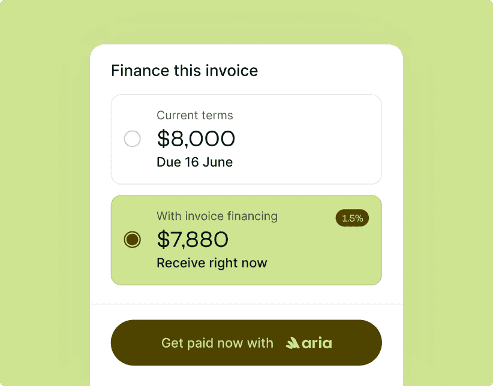
Once we’ve accepted the financing request, we purchase the invoice outright. That means the buyer now owes us, and we take responsibility if issues arise. If there’s a dispute over the invoice, the marketplace resolves it but since the terms and conditions are comprehensive, Aria is usually able to handle the collection process with emails and phone calls. Aria also has a professional recovery process if necessary. In any case, we cover the risk and the supplier gets paid.
This allows you to:
- Pay suppliers the same day as an invoice is validated.
- Protect your marketplace when a buyer defaults.
- Build loyalty with suppliers through transparent, dependable payment terms.
On the buyer side, they can pay following agreed payment terms – 30, 60, or even 90 days – allowing them to easily manage their cash flow and use regular invoicing and payment flows.
This lets you:
- Ease the pressure on your buyers’ cash flow.
- Save time and stress by having Aria handle repayments from buyers.
- Increase sales transaction volume and overall sales, thanks to flexible payment options and a smoother experience for everyone involved.
When suppliers get paid faster, they can reinvest immediately, accept more orders, and increase their sales. It also means that they are more likely to be loyal to your marketplace, than a different one where payments take weeks.
Aria lets you serve both sides, so your marketplace keeps sellers loyal, buyers happy, and transaction volume growing.
Enjoy greater peace of mind with Aria managing risk and payment collection
You want to offer financing to as many customers as possible, but you also need to protect your platform from bad actors. Verifying buyers and suppliers, analysing risk, and preventing fraud is critical, but often expensive, manual and slow. Aria has automated the process.
Our risk scoring capabilities give you the tools and insights you need to minimise fraud and payment risk. With Aria, dozens of checks that would normally take days – debtor solvency, KYC/KYB across 100+ countries, fraud detection, invoice validation – are completed automatically, with 92% of applicants receiving instant decisions.
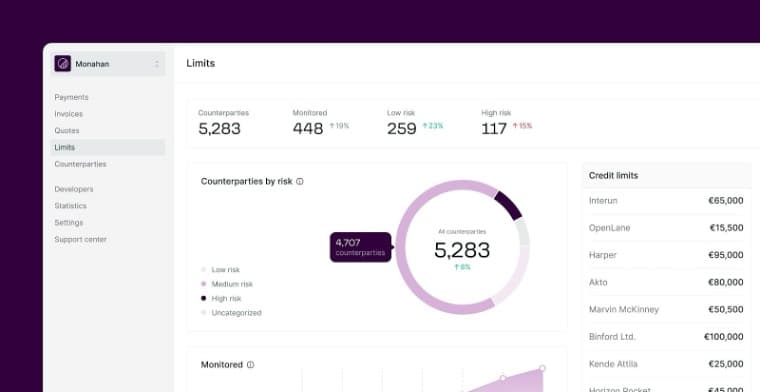
That level of automation allows you to offer financing to more customers as you can more easily determine which ones are the genuine customers. In fact, we’ve been able to offer close to 99% acceptance for corporations and 90% for SMEs.
With the technology we’ve developed, we only need a company registration ID to determine financing limits and advance funds. We’ll typically approve a verified company for an initial amount, for example €100k, and fund multiple invoices up to that limit. Additional transactions can then get funded as outstanding invoices are repaid.
We also proactively guard against payment issues. Our system automatically notifies users about payments with smart, timely (and friendly) triggers. If a buyer fails to pay on time, we step in to manage collections and cover losses. We’ll handle recovery with tact and humanity, so your relationships with users stay strong, and your team can focus on growth.
Altogether, it’s a system that works; our default rate currently stands at just 0.1%.
Scale effortlessly with custom integrations that fit your workflow
Bringing in a third-party to handle payment can be tricky. You don’t want to disrupt existing workflows, introduce extra steps for your customers, or complicate your team’s operations. Not to mention, the new solution can hinder rather than support your growth if it can’t evolve with you.
Aria is built to fit right into your workflow. Our flexible REST APIs let you tailor the experience to your system and brand. Self-service onboarding flows and white-labeled interfaces mean your customers can get financing without leaving the platform. This removes friction that might otherwise discourage sign-ups.
To improve the customer experience even further, buyers are provided with a single International Bank Account Number (IBAN), regardless of where they operate. This reduces errors while speeding up the processing for international transactions.
Our APIs also automate all of your payment flows. Choose when to trigger payments after invoices are received, define payment terms, and redirect payments anywhere. With one integration, you can process B2B payments across 100+ countries. We handle the rails – SEPA, SCT, SWIFT, FPS – and other complexities of international payment infrastructure.
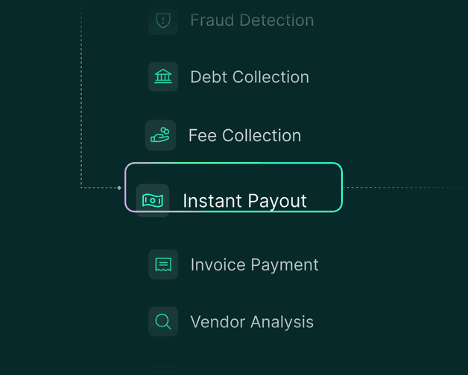
All of this adds up to a smoother payment experience for your customers. When payments are simpler and financing is accessible, suppliers stay loyal and overall volume increases. And as you grow, Aria scales right alongside you, supporting more users and your global expansion.
How Job&Talent went from 20 factoring partners to 1 with Aria
Job&Talent is an AI-powered workforce platform that matches skilled professionals and companies in essential industries. The two parties are connected by the platform, which is built to handle everything from hiring and shift scheduling to payroll and compliance.
In 2024 alone, Job&Talent placed 300,000 people in work and handled €1.8 billion in transactions. With such scale, “late payment culture” became a real challenge. Workers wanted immediate funds, while the companies wanted to pay later. This left an average 45-day window where Job&Talent had to cover payments “out-of-pocket.”
Before Aria, the company was forced to juggle 20 different factoring partners. To effectively manage growth across multiple countries and currencies, they needed a simpler and reliable solution.
Aria’s embedded invoice financing provided exactly that through its integration with NetSuite, which enabled automatic invoice transfers, with funds arriving in less than 24 hours. Tasks that previously required three people and hours of manual work could now be handled by one person in a third of the time.
The partnership was highly collaborative, with Job&Talent highlighting Aria’s flexibility and responsiveness. By adapting to the company’s specific needs, Aria made global financing easier, faster, and less resource-intensive. This lets Job&Talent focus on growth rather than payment headaches.
The future of financing is embedded, automated, and buyer-supplier friendly
Suppliers want cash immediately, while buyers need to comply with internal treasury policies and standard payment cycles. Traditional financing often helps one side but adds cost, complexity, or limits scalability.
Embedded invoice financing helps keep all parties happy. Suppliers get paid fast, buyers can use regular payment terms, and you avoid cash flow strain. Aria integrates directly into your workflow with flexible APIs, which makes it simple to set up and easy to scale. We also handle collections and defaults, absorbing the financial and operational risk of financing.
With Aria, every user gets a smooth payment experience from application process through repayment. See how we can help you offer financing to your customers by requesting a demo today.
FAQs: How to offer finance to customers
1. What’s the safest way to offer finance to customers without taking on balance sheet risk?
The safest way to offer finance to customers is by partnering with a third-party provider that assumes the credit risk and funds transactions upfront. Instead of using your own capital, embedded financing solutions (like invoice financing or consumer finance at POS) allow you to extend flexible payment terms (such as monthly instalments) while protecting your cash flow.
This approach lets you boost sales and increase transaction volume without turning your company into a lender or taking on regulatory and financial complexity.
2. Do I need FCA or Financial Conduct Authority approval to offer finance to customers?
Whether you need authorisation from the Financial Conduct Authority (FCA) depends on how you structure your financing offering.
If you directly provide consumer credit (e.g., lending to customers or offering regulated consumer finance products), you will likely need FCA authorisation and must comply with financial conduct authority regulations.
However, most marketplaces and SaaS platforms avoid this by:
- Partnering with a regulated lender or invoice financing provider
- Acting as an introducer rather than the credit provider
- Embedding financing at POS or online while the partner handles underwriting, compliance, and collections
3. How does offering finance to customers impact pricing, margins, and conversion rates?
When you offer finance to customers, you typically see higher conversion rates, larger order sizes, and more repeat purchases.
While there are costs involved, they can be offset through adjusted pricing, shared fees, and increased sales. For most B2B marketplaces and SaaS platforms, the ability to unlock demand from cash-constrained business owners far outweighs the margin impact.